
I remember the day I first thought about college. It wasn’t like a sudden lightning bolt; more like a slow, dawning realization that the world outside my neighborhood was vast and held possibilities I couldn’t quite grasp. My parents, bless their hearts, had always encouraged me to dream big, but when it came to the specifics of higher education – applications, deadlines, and the terrifying cost – we were all navigating uncharted waters. We were, as they say, a first-generation family stepping into the college world, and let me tell you, it felt like trying to read a map written in a language I didn’t speak.
The biggest, most intimidating monster lurking in the shadows of those college brochures was always the money. How would I pay for it? My family wasn’t poor, but we certainly weren’t rich. Every penny counted, and the idea of tuition fees, room and board, books, and living expenses felt like an insurmountable mountain. I saw my friends, whose parents had gone to college, talk casually about FAFSA forms and "financial aid packages." For me, it was a dizzying array of unfamiliar terms. That’s when I stumbled upon the word "scholarship." It sounded almost mythical, a golden ticket handed out only to the brightest, the most athletic, or the most unique. But I was just… me. A regular kid with big dreams and a lot of questions.
If you’re reading this, chances are you’re standing right where I once was. You’re a first-generation college student, or you’re helping one, and you’re wondering how on earth to pay for this incredible journey. Let me tell you, from one who’s been there, scholarships are not a myth. They are very real, and they are absolutely within your reach. They are the helping hand that can turn a daunting dream into a tangible plan. And what’s more, there are specific scholarships designed with you in mind – students like us, who are breaking new ground for our families.
My journey to understanding scholarships began with a lot of confusion and a fair bit of despair. I felt isolated, like I was the only one grappling with these unknowns. But then I learned to ask questions, to seek out resources, and most importantly, to understand that my "first-generation" status wasn’t a disadvantage, but a powerful story waiting to be told. It was a unique perspective, a testament to resilience, and something that many scholarship committees actively look for.
So, where do you even begin this treasure hunt for financial aid? Forget the idea that you need perfect grades or a Nobel Prize to your name. While academic excellence certainly helps, many scholarships value other qualities: leadership, community involvement, specific talents, and yes, your unique background as a first-generation student.
The first step, and this is crucial, is to understand what a scholarship truly is. It’s essentially free money that you don’t have to pay back. It’s an investment in your potential, offered by individuals, organizations, foundations, and even colleges themselves, who believe in the power of education and want to help deserving students achieve their goals. For first-generation college students, scholarships are often the bridge that connects aspiration with access.
My initial search started online, like most things do these days. I typed "scholarships for first-generation students" into every search engine I could find. And suddenly, a whole world opened up. Websites dedicated solely to scholarship listings became my new best friends. Sites like Fastweb, Scholarship.com, Chegg Scholarships, and College Board are fantastic starting points. They allow you to create a profile and match you with scholarships based on various criteria – your major, your ethnicity, your interests, your GPA, and yes, your first-generation status. Don’t be shy about filling out those profiles completely; the more information you provide, the better the matches will be.
Beyond the big national databases, I quickly learned the importance of looking closer to home. Local scholarships are often less competitive and can be surprisingly generous. Think about your high school guidance counselor – they usually have lists of local awards from community groups, businesses, and alumni. Your local library might have resources. Rotary Clubs, Lions Clubs, local chambers of commerce, even parent-teacher associations often offer scholarships to students from their community. These are often overlooked, but they can add up significantly. I remember applying for a scholarship offered by a small local bank – it wasn’t a huge amount, but every little bit helped chip away at that daunting total.
Another powerful resource is the financial aid office at the colleges you’re applying to or planning to attend. They are experts! They know about institutional scholarships – awards offered directly by the university – some of which are specifically earmarked for first-generation students. Don’t be afraid to call them, email them, or even visit if you can. Ask them directly, "Do you have any scholarships for first-generation students? Are there any specific grants or aid programs I should know about?" Their knowledge can be invaluable.
Now, let’s talk about specific types of scholarships that are particularly relevant for us, the first-generation trailblazers:
-
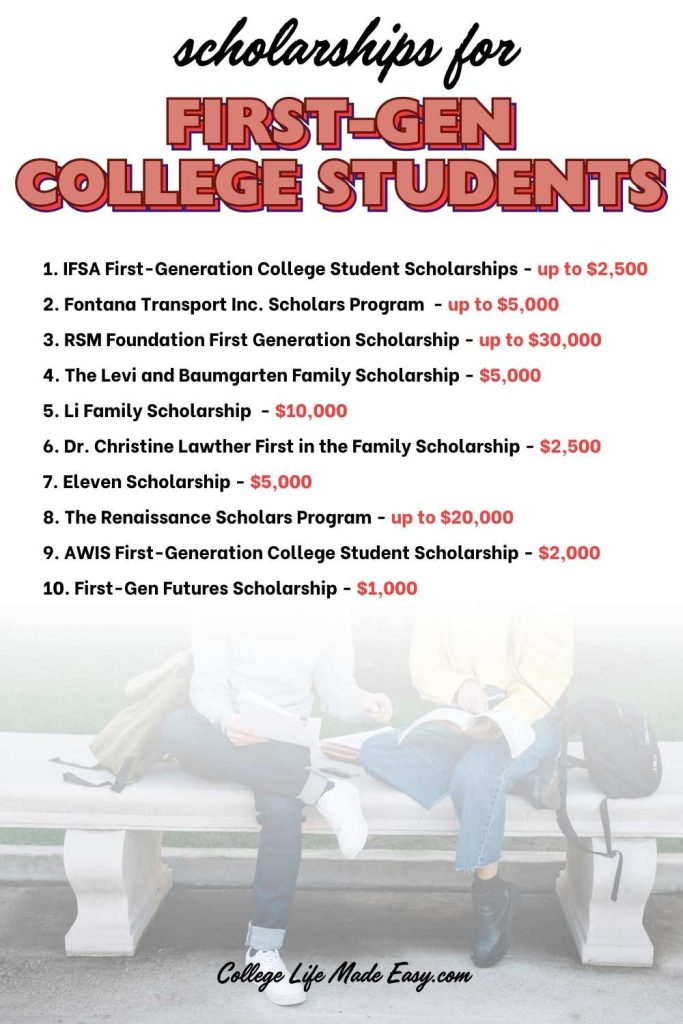
First-Generation Specific Scholarships: This is the obvious one, but it’s worth highlighting. Many foundations and universities have recognized the unique challenges and immense potential of students who are the first in their families to attend college. They want to support you. Look for scholarships with "first-generation" explicitly in their title or description. Examples might include the Dell Scholars Program, the Coca-Cola Scholars Program (which often considers first-gen status), and various university-specific programs.
-
Need-Based Scholarships: Since many first-generation students come from families with limited financial resources, need-based scholarships are often a perfect fit. These are awarded based on your family’s financial situation, usually determined by your FAFSA (Free Application for Federal Student Aid) and CSS Profile. Don’t ever skip filing these forms! They are the gateway to federal and state grants (which are also free money!), as well as many institutional scholarships. Even if you think your family makes "too much," file it anyway. You might be surprised.
-
Merit-Based Scholarships: While grades aren’t everything, don’t discount your academic achievements. If you’ve worked hard and maintained a good GPA, many universities offer merit scholarships based on academic performance, test scores, or specific talents (like music, art, or athletics). Even if you’re not a straight-A student, showing significant improvement or excelling in particular subjects can catch a committee’s eye.
-
Community and Leadership Scholarships: Did you volunteer at a local shelter? Start a club at school? Help organize a fundraiser? These activities demonstrate leadership, initiative, and a commitment to making a difference. Many organizations reward students who show these qualities. These are perfect opportunities to show how you’ve overcome challenges and contributed positively to your community, often reflecting the resilience that first-generation students inherently possess.
-
Demographic and Identity-Based Scholarships: There are countless scholarships available for students from specific ethnic backgrounds, religious affiliations, gender identities, or those pursuing certain majors (like STEM fields, education, or healthcare). For instance, if you’re a woman interested in engineering, or a minority student pursuing medicine, there are specific funds set aside for you. Explore these avenues; your identity can be a key to unlocking financial aid.
Once you’ve found a handful of promising scholarships, the real work begins: the application process. This is where many people get overwhelmed, but break it down into smaller steps, and it becomes manageable.
First, read the instructions carefully. Seriously, I cannot emphasize this enough. Each scholarship has specific requirements. Missing even one small detail can disqualify you. Pay attention to eligibility criteria, required documents, and word limits for essays.
Next, gather your documents. This usually includes your high school transcripts, standardized test scores (if applicable), your FAFSA Student Aid Report (SAR), and letters of recommendation. For letters of recommendation, choose teachers, counselors, or mentors who know you well and can speak genuinely about your character, work ethic, and potential. Give them plenty of notice – at least two to three weeks – and provide them with a "brag sheet" outlining your achievements, goals, and why you’re applying for this particular scholarship. Make it easy for them to write a fantastic letter for you.
Then comes the heart of many applications: the essay. This is your chance to shine, to tell your story, to let your personality and passion come through. For first-generation students, your essay is your superpower. Scholarship committees want to hear about your journey. They want to know what motivates you, what challenges you’ve overcome, and how being a first-generation student has shaped your aspirations.
Don’t be afraid to be vulnerable and authentic. Talk about the unknowns, the struggles, the pride you feel in being a pioneer for your family. Connect your experiences to your future goals. For example, if your parents immigrated and worked incredibly hard, you could talk about how their perseverance inspires your own drive to succeed in college and beyond. If you had to figure out the college application process mostly on your own, talk about the resourcefulness and independence you developed. Show, don’t just tell, who you are and why this scholarship matters to you.
When I wrote my essays, I focused on my deep desire to give back to my community, a value instilled in me by my family. I talked about how my experiences taught me resilience and how I planned to use my education to create opportunities not just for myself, but for others like me. Make sure your essay directly answers the prompt and demonstrates why you are a deserving candidate.
After you’ve drafted your essay, proofread, proofread, proofread! Then, ask someone else to proofread it. A fresh pair of eyes can catch errors you missed. A grammatically correct, well-written essay shows attention to detail and respect for the committee’s time.
Finally, and this is a big one: meet your deadlines. Mark them on your calendar, set reminders, do whatever it takes. A late application is a missed opportunity, no matter how brilliant it is. I learned to submit applications a few days early, just in case of technical glitches or last-minute issues.
Throughout this entire process, you’re going to encounter roadblocks. You might get rejected from some scholarships. I certainly did. It can feel disheartening, like all your hard work was for nothing. But don’t give up. Think of each application as practice, a step closer to the one that says "yes." Persistence is key. The more scholarships you apply for, the better your chances. It’s a numbers game, but it’s also about finding the right fit.
One pitfall I saw many of my peers fall into was procrastination. They’d wait until the last minute, rush their applications, and then wonder why they didn’t get selected. Start early. Create a spreadsheet to track deadlines, requirements, and submission status. Treat scholarship hunting like a part-time job – dedicate a few hours each week to searching and applying.
Another important point: beware of scholarship scams. If a scholarship asks you to pay a fee to apply, or guarantees you a scholarship for a fee, it’s almost certainly a scam. Legitimate scholarships never ask for money to apply. Also, be cautious about sharing personal information with unfamiliar websites. Stick to reputable scholarship search engines and official university sites.
Once you start receiving those "yes" letters, the feeling is incredible. It’s not just about the money; it’s a validation of your hard work, your potential, and your unique journey. But the work doesn’t stop there. Most scholarships have conditions – maintaining a certain GPA, volunteering hours, or participating in specific programs. Make sure you understand and fulfill these requirements to keep your funding.
Beyond the financial aspect, scholarships can open doors to networks and opportunities. Many scholarship programs offer mentorship, workshops, and connections to other scholars and professionals. Embrace these opportunities! They can be just as valuable as the money itself, providing you with a support system as you navigate your college years.
Being a first-generation college student is an incredible achievement. You are blazing a trail, setting an example for your family and future generations. It’s a path filled with unique challenges, but also immense pride and potential. Don’t let the financial burden deter you from pursuing your dreams. Scholarships are out there, waiting for students like you to claim them.
My advice to you, a fellow first-generation student, is to believe in your story. Your journey is powerful, inspiring, and exactly what many scholarship committees are looking for. Be diligent in your search, meticulous in your applications, and persistent in your efforts. Ask for help when you need it – from counselors, teachers, financial aid officers, and even older students who have been through the process. You are not alone in this. There’s a whole community ready to support you.
The path to higher education for first-generation students can feel like an uphill climb, but with scholarships, that climb becomes less steep, and the view from the top becomes clearer. You have the grit, the determination, and the unique perspective to succeed. Now go out there, tell your story, and claim the financial support you deserve. Your future, and the future you’re building for your family, is waiting.